If you’ve started looking for someone to marry you, you’ve probably encountered a handful of different titles: wedding officiant, celebrant, ordained minister, justice of the peace. The simplest distinction is that a wedding officiant is someone authorized to perform a legal marriage, while a wedding celebrant generally specializes in creating and performing personalized ceremonies. There is plenty of overlap between the two, especially in the United States. I am both.
But I think there’s a more useful question to ask when you’re deciding who you want standing with you on your wedding day: What are you actually asking this person to do?
There are many perfectly lovely ways to get married. You can exchange vows before a judge, have a minister perform a traditional religious service, ask someone you love to officiate, or hire a professional. What matters is understanding the kind of ceremony you want and choosing someone whose work matches it.
What does a wedding celebrant actually do?
When I describe myself as a celebrant, I’m talking about much more than my authority to legally marry two people. I’m talking about the work of creating the ceremony itself.
I don’t begin with a wedding script and look for places to insert your names and a few details about how you met. I begin with the two of you. I want to understand who you are, how you love one another, what you’ve weathered together, the people and traditions that have shaped you, and what you’re choosing when you choose marriage.
Then I have to decide what to do with everything you’ve entrusted to me. That’s where storytelling comes in. Creating a ceremony isn’t simply collecting good material. It’s recognizing which details matter, understanding what they reveal, and deciding how to put them together. A story about something completely ordinary can sometimes tell me more about a marriage than the grandest romantic gesture. A family tradition can carry generations of meaning. A ritual can allow everyone gathered to participate in something that words alone couldn’t accomplish.
The ceremony begins to take shape from there. Personal stories might sit alongside cultural or religious traditions, readings, remembrance, vows, rings and ritual. The work is in making all of those pieces belong together so that the ceremony has an arc and feels like one experience rather than a collection of wedding elements.
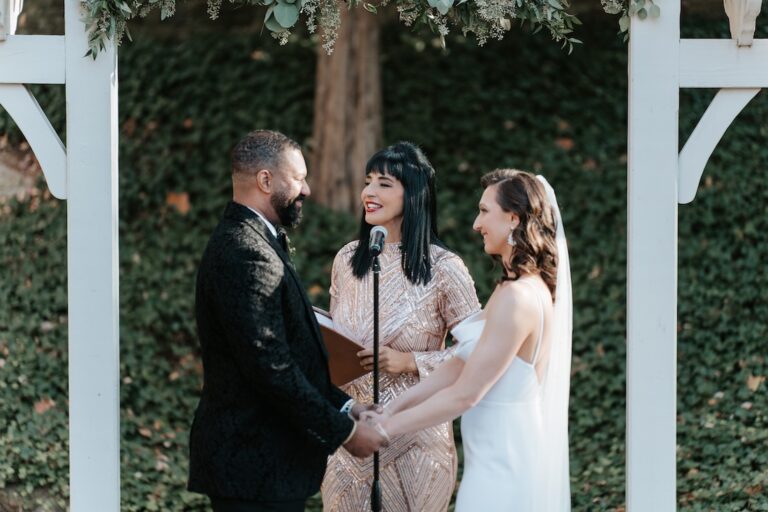
And then there is another part of the job entirely: performing it. I’ve learned over more than 1,000 ceremonies that there is an art to holding a room while helping the two people at the center forget, for a little while, that everyone is watching. You learn when to speak and when to pause, when to let the laughter linger, when a moment needs another breath, and how to use your voice to carry a story without becoming the story. And you learn what to do when someone faints. That wasn’t in the celebrant training, but experience has a way of expanding the job description.
The writing matters. So does the person entrusted to bring it to life.
What makes a custom wedding ceremony different?
One of the things more than 1,000 ceremonies has taught me is that the most meaningful details aren’t necessarily the most dramatic ones.
Of course I want to know how you met and fell in love. But I’m often more interested in what happened afterward: how you’ve changed one another, what you’ve made it through together, what makes you laugh, what you admire about each other, and what you’ve learned about loving this particular person.
Two of my favorite questions are:
How do you feel loved by your partner?
What is the kindest thing your partner has ever done for you?
The answers are almost never about grand gestures. They’re usually found in the ordinary moments of a shared life, and very often, those details reveal something about a relationship that a chronological retelling of how two people met simply cannot.
My job is to recognize those details, understand what they say about the couple, and create a ceremony that allows everyone gathered to recognize it, too. That’s the difference between inserting a few personal details into a ceremony template and creating something from scratch.
Is a celebrant the same as an ordained minister?
Not necessarily. Ordination and celebrant training serve different purposes, although one person can certainly have both.
Ordination can provide a pathway to legal authority to solemnize marriages, depending on the laws where the wedding takes place. Celebrant training, on the other hand, focuses on the art and practice of ceremony: its structure, symbolism, storytelling, ritual and delivery.
Some celebrants are ordained ministers, while others are not. Some work exclusively with secular ceremonies, while others incorporate spiritual, religious or cultural traditions according to the wishes of the people they’re serving.
I trained at the Celebrant Institute and Foundation and am also an ordained minister through the Universal Brotherhood Movement. I even founded my own congregation, the Bacon & Lox Society, a celebration congregation whose members gather throughout the year to create and perpetuate our favorite traditions around a shared table.
For me, these paths complement one another. One gives me the framework for legally joining two people in marriage, while the others reflect something I’ve believed for a long time: gathering people with intention, whether for a wedding, a holiday, or simply the pleasure of being together, is something worth celebrating.
Does a wedding celebrant perform religious or nonreligious ceremonies?
Both are possible, and one of the things I appreciate most about creating ceremonies from scratch is that they don’t need to fit neatly into a predetermined category.
A couple might want to honor their religious upbringing without having a traditionally religious wedding. They might come from different cultural backgrounds, want to incorporate particular family traditions, or envision a completely secular ceremony that still feels deeply reverent. A custom ceremony gives us room to consider those things thoughtfully and find ways to bring them together.
The question isn’t necessarily whether the ceremony should be traditional or unconventional. It’s whether the choices we make feel meaningful to the two people getting married.
Can a friend or family member be your wedding officiant instead?
Absolutely, provided they meet the legal requirements where the marriage takes place. There’s something wonderful about asking a person who already knows and loves you to stand beside you when you get married. They bring a relationship that no professional can replicate.
One thing I encourage Friend Officiants™ to be mindful of, though, is developing an equally meaningful connection with both members of the couple. Often, the person asked to officiate is someone’s uncle, childhood friend, coach or sibling. They may have decades of stories about one person and only a handful about the other. It’s important to spend time getting to know both people individually so that the ceremony is balanced, and both feel equally seen and represented in the words being prepared.
And, of course, loving the couple doesn’t automatically mean knowing how to write, structure and deliver a wedding ceremony. That’s why I created the Wedding Ceremony Master Class™ and began offering private coaching for Friend Officiants™.
Because knowing and loving the couple is the part I can’t teach. The rest, I can help with.
[Explore the Wedding Ceremony Master Class™]
How do you choose between a wedding celebrant and an officiant?
I’d begin by thinking about what you want to experience during your ceremony. Are you looking for someone to conduct a brief, traditional service? Someone to help you navigate the legal requirements? Someone to create an original ceremony around your relationship? Or someone to help a beloved friend or family member do the honors? Those are all legitimate ways to approach getting married.
When speaking with a prospective celebrant or officiant, I’d suggest asking a few questions:
- Do you write ceremonies from scratch or customize an existing script?
- How do you get to know the couples you work with?
- Can we incorporate our own cultural, religious or family traditions?
- Will we have an opportunity to contribute to the ceremony as it’s being created?
- Are you legally authorized to officiate our marriage in the location we’ve chosen?
The answers will tell you considerably more than the person’s professional title.
One last thought about the ceremony itself
I often remind couples that their wedding ceremony is the part of the day everyone has gathered to witness. It’s where the reason for the celebration becomes visible.
And when a ceremony is deeply personal, something lovely happens. The guests aren’t simply watching two people get married. They’re learning something about them, laughing at stories they recognize, discovering things they didn’t know, and becoming part of a shared experience. That experience gives meaning and context to everything that follows.
And afterward, people are talking about the ceremony at cocktail hour. Which, after more than 1,000 ceremonies, is still one of my favorite compliments.
For couples who believe the ceremony matters.
[Explore Custom Wedding Ceremonies]
Frequently Asked Questions
Is a wedding celebrant legally allowed to marry you?
A celebrant can legally officiate a wedding if they meet the requirements of the jurisdiction where the marriage takes place. The professional title alone does not establish legal authority.
What’s the difference between a celebrant and a wedding planner?
A wedding planner coordinates the broader wedding experience, including vendors, logistics and scheduling. A celebrant specializes in creating and performing the ceremony itself.
Can a celebrant include religious traditions?
Yes. Many celebrants create secular, spiritual, interfaith and culturally personalized ceremonies, depending on their training, approach and the couple’s wishes.
Do celebrants write their own wedding scripts?
Many professional celebrants specialize in original ceremony writing. However, approaches vary, so it’s worth asking whether the ceremony will be written from scratch or adapted from a template.
Can I hire a celebrant to help my friend officiate our wedding?
Yes. Some celebrants offer ceremony-writing assistance, private coaching and officiant education for friends and family members who have been asked to perform a wedding.